
When buyers start specifying industrial casters, one of the first decisions they face is also one of the most consequential: should the wheel tread be rubber or nylon? The two materials look similar on a parts list, yet they behave very differently on the factory floor. Rubber casters are famous for quiet, floor-friendly rolling, while nylon casters are prized for strength, low weight and exceptional wear life. Choosing the wrong one can mean cracked wheels, scratched epoxy floors, noisy work cells or premature bearing failure. This guide explains exactly what sets rubber and nylon casters apart, compares them across ten practical dimensions, and gives you a decision framework so you can select the right material the first time.
What Are Rubber Casters and What Makes Them Unique?
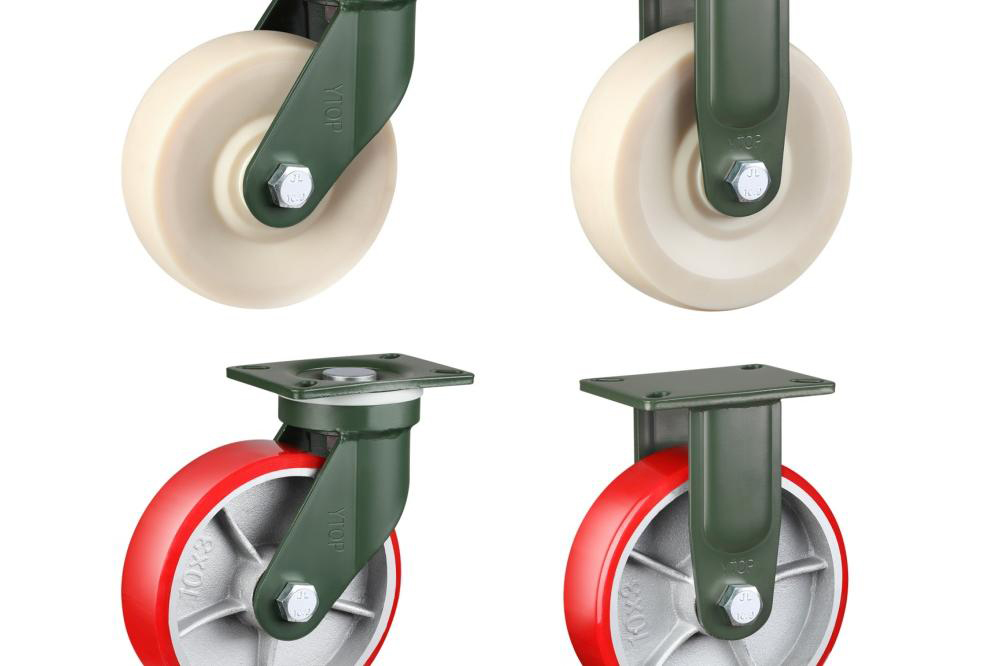
Rubber casters are wheels molded or vulcanized from natural or synthetic rubber compounds, often bonded to a cast-iron or plastic core. The defining property of rubber is viscoelasticity: the tread deforms under load and rebounds, rather than rolling as a rigid surface. That single property drives nearly every advantage rubber can offer, and also its limits.
Elasticity, Shock Absorption and Quiet Rolling
Because the tread compresses slightly, rubber absorbs impacts from expansion joints, cracks, thresholds and small debris. Instead of transmitting a sharp jolt through the cart frame into fragile contents, the rubber wheel “gives” a few millimeters and dissipates the energy. The same deformation damps vibration and prevents the hard, ringing noise produced by rigid wheels on concrete. A well-designed rubber caster rolling on a smooth floor is typically the quietest option available, which is why hospitals, libraries, hotels and office buildings almost universally specify rubber or rubber-like treads. The trade-off is that the softer contact patch increases rolling resistance compared with a rigid wheel, so more pushing effort is required, especially on rough or wet surfaces.
Floor Protection, Grip and Rough-Surface Performance
The compliant tread also protects the floor. Rubber grips rather than skids, it rarely leaves black scuff marks on properly formulated non-marking compounds, and it does not chip or crack epoxy, tile or terrazzo the way hard wheels can. On outdoor sites, courtyards, cobblestone paths and unfinished concrete, rubber is more forgiving because it bridges small imperfections. Rubber does, however, wear faster under heavy static loads and sharp turns, and it can be attacked by oils, greases, solvents and petroleum-based fluids, causing swelling, hardening or surface crazing. Heat is another enemy: standard rubber loses resilience above roughly 60 to 80 degrees Celsius and can soften or degrade in direct flame or near furnaces.
What Are Nylon Casters and What Makes Them Unique?
Nylon (polyamide, usually PA6 or PA66) casters are injection-molded engineering thermoplastic wheels. Unlike rubber, nylon is a rigid, low-friction material that holds its shape under very high point loads. It is the default choice when the job is heavy, wet, chemically aggressive or demanding long wear life.
Toughness, Light Weight and Smooth, Low-Effort Rolling
Nylon is remarkably strong for its density. A nylon wheel is roughly one-third the weight of a cast-iron wheel of the same diameter, yet it supports several hundred kilograms per wheel without permanent deformation. Its low coefficient of friction on a smooth floor means a loaded cart rolls with far less push effort than an equivalent rubber caster, which is a major ergonomic and energy-saving advantage in automated guided vehicles (AGVs), tow lines and hand-pushed assembly carts. Nylon also keeps spinning freely in cold rooms where rubber would stiffen and become noisy.
Wear Resistance, Chemical Resistance and No-Marking Rolling
Properly formulated nylon resists abrasion, oils, greases, many solvents, weak acids and alkalis, and it will not rot or swell with age. It is dimensionally stable in high-humidity and wash-down environments such as food, pharmaceutical and chemical plants. A high-quality nylon wheel leaves no black marks on most floors and does not shed the rubber dust that accumulates around soft treads. The downsides are that rigid nylon transmits vibration rather than absorbing it, it can be noisy on rough or expansion-jointed concrete, it can scuff or dent soft floor coatings under concentrated load, and it becomes brittle in very low temperatures or under sharp impacts, occasionally chipping rather than deforming.
Rubber vs Nylon Casters: Side-by-Side Comparison
The table below summarizes the ten dimensions that matter most during selection. Ratings are relative: more stars mean stronger performance for that criterion within typical industrial-grade products.
| Criterion | Rubber Casters | Nylon Casters |
|---|---|---|
| Load capacity per wheel | Moderate (often 80-300 kg) | High (300-1,000+ kg) |
| Abrasion / wear life | Good, but softer tread wears faster | Excellent on smooth floors |
| Noise level | Very quiet | Noticeable on rough joints |
| Shock / vibration absorption | Excellent | Poor (rigid) |
| Floor protection | Excellent, non-marking available | Good, but can dent soft floors |
| Temperature range | Roughly -20 to +80 °C | Roughly -30 to +100 °C |
| Chemical / oil resistance | Limited; oils and solvents attack it | Excellent |
| Rolling resistance / push effort | Higher (softer tread) | Lower (rigid, low friction) |
| Wheel weight | Heavier with metal core | Lightweight |
| Typical relative cost | Low to medium | Medium to high for precision grades |
Which Applications Favor Rubber, and Which Favor Nylon?
Best Applications for Rubber Casters
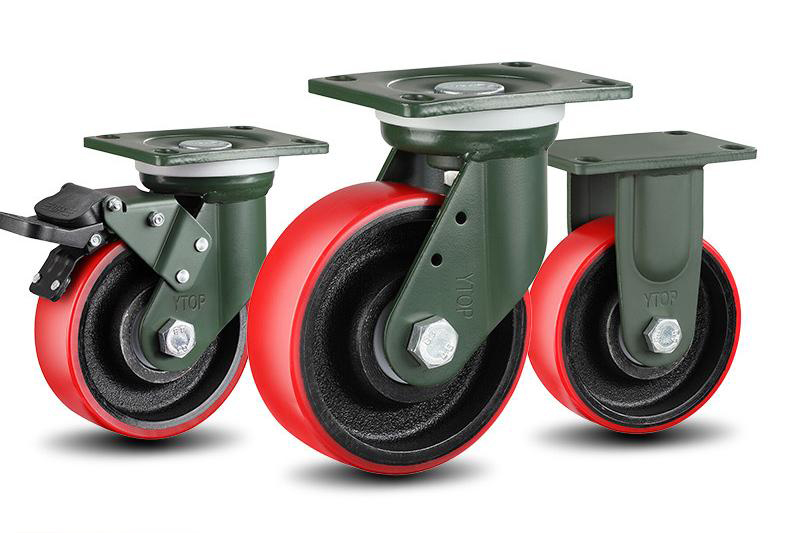
Choose rubber when floor protection and quiet operation dominate. Hospital beds and stretchers, hotel luggage carts, supermarket checkout stands, office furniture, presentation and stage equipment, laboratory instruments, and any cart that must roll across tile, epoxy or polished concrete with fragile or noise-sensitive contents benefit from rubber. Outdoor trolleys crossing uneven ground, garden paths or rough paving also favor the compliant tread. If your facility has a decibel limit, a clean-room-adjacent area, or a polished floor you must not scratch, rubber is usually the safer starting point.
Best Applications for Nylon Casters
Choose nylon when load, chemistry and wear dominate. Heavy material handling carts, injection-molding machines, die carts, warehouse racks, AGV and AMR platforms, food and chemical processing equipment, and wash-down or cold-storage cells all favor nylon. Nylon also wins when push effort must stay low over long distances on a smooth, level concrete floor, or when oils and cutting fluids would degrade rubber. For multi-ton loads, nylon wheels are typically paired with forged steel brackets and dual-wheel swivel heads rather than used alone.
How to Choose: A Practical Decision Guide
Start with four questions before comparing price tags. First, what is the total weight of the loaded cart, and how many wheels carry it? Divide total weight by the number of wheels and add a 30 to 50 percent safety margin for shocks and uneven floors; that figure tells you whether you need a medium-duty, heavy-duty or super-heavy-duty grade. Second, what is the floor like? Rough outdoor concrete favors rubber; smooth indoor epoxy with chemicals favors nylon. Third, are there constraints on noise, floor marking or vibration? If yes, lean rubber. Fourth, what chemicals, temperatures or wash-downs will the wheel meet? If oils, solvents, acids or hot steam are present, lean nylon or polyurethane rather than plain rubber.
When the two materials seem tied, remember that polyurethane (PU) treads often sit between them: they combine nylon-like wear and chemical resistance with rubber-like quietness and floor protection. If neither rubber nor nylon fully fits your application, ask a manufacturer about PU alternatives. You can review our heavy-duty caster range (150-610 kg per wheel) and our medium-duty caster range (100-190 kg per wheel) to see both rubber and nylon wheel options across load classes.
Maintenance and Care for Long Wheel Life
Whichever material you choose, simple habits double or triple wheel life. Keep the tread free of wire, string, strapping and debris that wrap around the axle. Lubricate swivel races and bearings with the manufacturer-recommended grease; dry nylon-on-nylon bearings squeal and wear quickly, while rubber-rimmed wheels do not need tread lubrication. Wipe chemical spills off nylon wheels to avoid long-term stress cracking, and keep rubber wheels away from direct contact with petroleum products and sustained ultraviolet light, which oxidize the rubber surface. Inspect tread wear at the same interval for all casters on a cart: uneven wear signals misaligned mounting brackets or overloading, and a single flat-spotted wheel will ruin the smooth roll of the whole assembly. When a wheel reaches roughly half its original diameter or develops chunks missing from the tread, replace it rather than waiting for a failure.
Frequently Asked Questions
Are rubber casters quieter than nylon casters?
Yes. The compliant rubber tread absorbs impact noise from floor joints and small obstacles, while rigid nylon wheels ring or click on expansion joints. In hospitals, offices and hotels, rubber or non-marking rubber treads are almost always specified for this reason. On perfectly smooth concrete, however, the noise difference narrows considerably.
Which caster material supports the heaviest loads, rubber or nylon?
Nylon. Because the tread does not deform permanently under point loads, nylon wheels are available in load ratings from 300 kg to well over 1,000 kg per wheel. Rubber treads spread load but compact under sustained pressure, so they are generally limited to medium-duty classes unless reinforced with a metal core or used as a coating over a rigid center.
Do rubber casters mark or scratch epoxy floors?
Standard black rubber can leave scuff marks, but non-marking or thermoplastic rubber (TPR) compounds are formulated specifically to roll cleanly on epoxy, tile and terrazzo without black streaks. Nylon rarely marks but can concentrate pressure and dent soft floor coatings under heavy static loads.
Can I use nylon casters outdoors on rough ground?
Nylon works outdoors in many applications, but on rough, cracked or gravelly surfaces the rigid tread transmits every impact directly to the cart and contents, and sharp debris can chip the wheel. For uneven outdoor terrain, rubber or pneumatic wheels are usually more comfortable and durable.
Which is cheaper, rubber or nylon casters?
At equal load ratings, simple rubber casters tend to cost less, while engineered nylon wheels with precision bearings and forged brackets can cost more. The smarter comparison is total cost of ownership: a slightly more expensive nylon wheel that lasts three times longer in an oil-wet plant floor often beats the cheaper rubber option that swells and fails within months.
Related Reading
Keep exploring caster material selection and performance:
- Polyurethane vs Nylon Swivel Casters: Wear Resistance and Load Comparison
- Advantages and Disadvantages of Nylon Wheels for AGV Casters
- How to Calculate Industrial Caster Load Capacity: Dynamic vs Static Load
- How to Properly Use Industrial Casters to Extend Service Life
- Core Parameters to Confirm When Selecting Industrial Casters
- Heavy-Duty Casters (150-610 kg)
- Medium-Duty Casters (100-190 kg)
- Contact our caster engineering team for material selection help
Post time: May-20-2024