
“What specifications do I need?” is the question every buyer asks when a cart, rack, machine or enclosure finally needs to move. The answer is not a single number; it is a small set of interlocking measurements, ratings and material choices that must all line up. A caster that looks correct on the box but has the wrong mounting height, stem diameter or load rating will either not bolt on or fail within weeks. This guide walks through the caster specifications you are most likely to encounter in a standard product catalog, explains what each one means in practice, and shows you how to measure them so the parts you order actually fit.
Wheel Diameter Specifications (40-200 mm and Beyond)
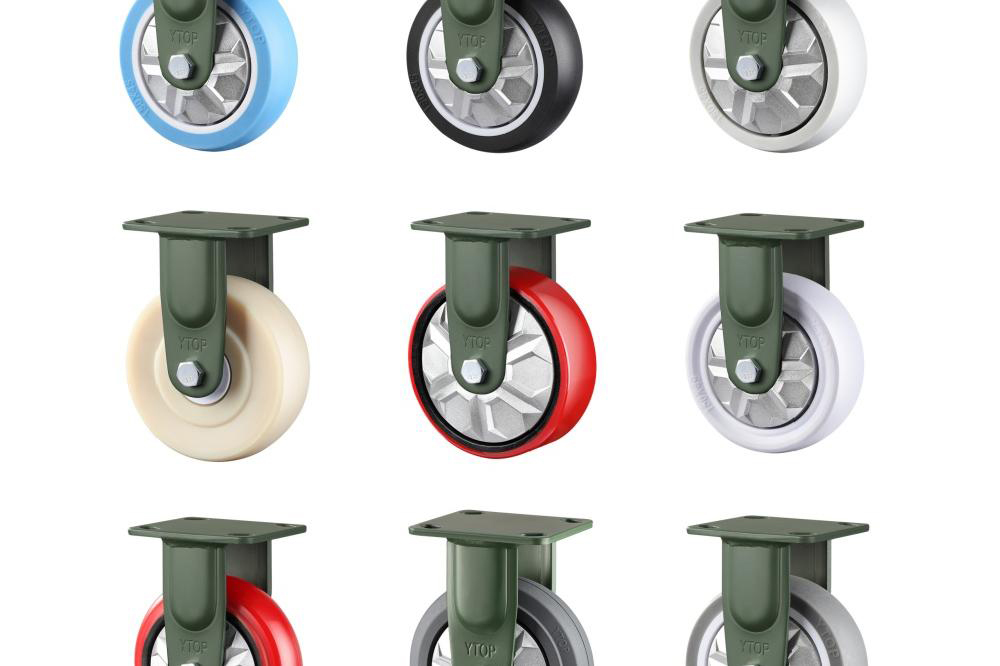
Wheel diameter is the first number on almost every caster label, and it is the primary lever you have over rolling effort and obstacle clearance. Standard industrial diameters cluster around 40, 50, 65, 75, 80, 100, 125, 150, 160 and 200 mm, with heavy-duty series reaching 250 mm or more. Smaller wheels (40-75 mm) fit tight spaces and lightweight furniture but struggle over cracks, thresholds and expansion joints. Larger wheels (125 mm and up) roll more easily over obstacles, distribute load over a longer contact patch, and require less push effort for a given weight.
Why Diameter Drives Effort and Obstacle Clearance
A larger wheel climbs an obstacle more gradually because its attack angle is shallower: a 100 mm wheel rolls over a 10 mm lip far more comfortably than a 50 mm wheel. Diameter also affects rolling resistance, because a larger wheel deflects less and rotates fewer times per meter traveled. The practical rule of thumb is to choose the largest diameter your mounting height and clearance allow, then trim down only when space or cost forces you to.
Wheel Width and Contact Area
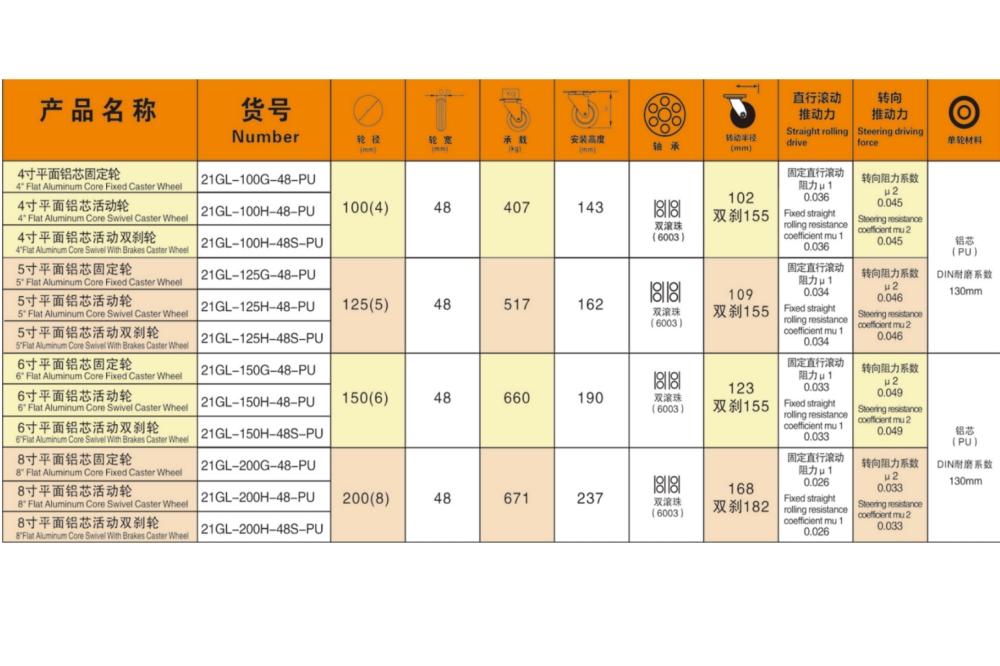
Wheel width determines how the load spreads onto the floor. A wider wheel lowers contact pressure, which protects soft epoxy or coated floors and reduces the chance of digging into soft surfaces, but it also increases the swivel torque required to turn the cart and adds cost. Light-duty furniture wheels are commonly 20-30 mm wide, medium-duty cart wheels 30-50 mm, and heavy-duty industrial wheels 50-75 mm or more. Under extremely high point loads, manufacturers may use two narrower wheels side by side (a dual-wheel swivel head) rather than one very wide tire, because the pair swivels more easily and shares shock between two treads.
Mounting Height and How to Calculate It
Mounting height (also called overall height or custer height) is the vertical distance from the floor to the top of the mounting plate or stem when the caster is standing vertically. It is the dimension that actually decides whether a piece of equipment will sit level after the casters are installed. The formula is straightforward:
Mounting height = wheel radius + bracket offset + any mounting hardware thickness.
Because a swivel caster’s yoke holds the wheel slightly below the center of the swivel bearing, the mounting height is not exactly the wheel diameter plus bracket; it must be read from the manufacturer’s drawing. When replacing existing casters, always measure the old wheel’s overall height first rather than its diameter, because two wheels of the same diameter can have different mounting heights depending on fork design. When mixing swivel and rigid casters on the same cart, their mounting heights must match within a tight tolerance, or one corner will carry far more weight than the others and wear prematurely.
Mounting / Fixing Types: Plate, Stem, Threaded, Grip-Ring and Pin
The fixing method is how the caster attaches to the equipment, and it must match the hole pattern already on your cart or machine frame. Five styles dominate the market.
Common Mounting Styles Compared
- Top plate (plate mount): A stamped steel plate with four bolt holes, the most common industrial style. Strong, easy to retrofit, and available in standardized hole patterns. Best for medium to super-heavy loads.
- Threaded stem: A male screw (commonly M8, M10, M12, M16) that screws into a tapped hole or is secured with two lock nuts. Compact and popular for furniture, kiosks and light machinery.
- Grip-ring / grip-neck stem: A smooth stem with a spring-loaded ring that snaps into a round hole in the frame. Fast to install and remove, typical on office chairs, medical carts and light racks.
- Expansion / plug stem: A ribbed plastic or rubber plug pressed into a tubular leg. Common on tubular furniture and wire shelving.
- Pin / kingpin hole: A plain shaft inserted through a bracket and held with a cotter pin or bolt. Used on agricultural, scaffolding and heavy equipment where quick removal is needed.
When retrofitting, measure the existing hole pattern: for plate mounts, record the outer plate dimensions and the center-to-center hole spacing in both directions; for stems, record diameter, thread pitch and exposed length. Mismatched mounting dimensions are the single most common reason a “correct” caster cannot be installed.
Load Capacity Grades: Light, Medium, Heavy and Super-Heavy
Caster catalogs group products by load per wheel rather than by total cart weight, because a four-wheel cart never perfectly distributes its load. The four standard grades used across the industry are:
| Grade | Load per wheel | Typical applications |
|---|---|---|
| Light duty | 35-80 kg | Furniture, kiosks, display racks, light carts |
| Medium duty | 100-190 kg | Workstation carts, tool cabinets, supermarket trolleys |
| Heavy duty | 150-610 kg | Machinery bases, die carts, warehouse racks, AGVs |
| Super heavy duty | 700-1,600 kg+ | Engine stands, mold carts, container dollies, automation frames |
Matching the Grade to Your Equipment
To choose a grade, calculate the total loaded weight of the cart, divide by the number of casters, and then multiply by a safety factor of at least 1.3 to 1.5 to account for shocks, uneven floors and the fact that one wheel may briefly carry more than its share. A 1,000 kg cart on four wheels needs at least 250 kg per wheel before the safety factor, so a heavy-duty grade is required even though the arithmetic seems to suggest medium duty. Never size a caster to exactly the average load; that is the most common cause of collapsed wheels in service.
Wheel Tread Materials, Bearing Types and Brake Types
Wheel Tread Materials
The tread material determines grip, noise, chemical resistance and floor protection. Rubber and TPR offer quiet, floor-friendly rolling for light to medium loads. Nylon (PA6/PA66) is rigid, strong and chemical-resistant for heavy industrial use. Polyurethane (PU) is the versatile middle ground, combining nylon-like wear with rubber-like quietness. Polypropylene (PP) is a low-cost, lightweight option for light duty. Metal (cast iron, forged steel) wheels are reserved for the highest temperatures and heaviest static loads but are noisy and floor-abrasive.
Bearing Types
Cheaper casters use a plain bore or a sleeve (plain) bearing, which is fine for light, infrequent use. Roller bearings handle medium loads and frequent movement. Precision ball bearings (sealed, double-shielded) give the smoothest, lowest-effort roll and are standard on heavy-duty and AGV casters. For dirty, wet or wash-down environments, choose sealed ball bearings with rubber shields rather than open rollers, which trap debris and wear quickly.
Brake Types
Three brake styles are common. A side (face) brake presses a pad against the tread and locks only the wheel, leaving the swivel free to rotate. A total-lock (dual) brake locks both the wheel and the swivel race, so the caster cannot roll or turn, which is the safest choice for sloped floors and work cells. A pedal or floor lock (jack) is a separate device that lowers a support foot to lift the wheels slightly off the floor; it is used when equipment must remain rigidly fixed for long periods. As a rule, brake every swivel caster on a cart, and reserve total-lock brakes for the positions where rigidity matters most.
How to Measure and Select the Right Caster in Five Steps
Follow this sequence to avoid ordering the wrong part. First, weigh the fully loaded cart and divide by the number of wheels, then apply the 1.3-1.5 safety factor to get required load per wheel. Second, measure the mounting height of the existing caster (or the available clearance under the new frame) and pick a wheel diameter that fits. Third, identify the mounting type and hole pattern, and record stem diameter and length if applicable. Fourth, choose a tread material based on floor condition, noise limits and chemicals present. Fifth, decide on brakes and bearings, and confirm the swivel configuration (typically two rigid plus two swivel casters for long carts, or four swivel casters for tight maneuverability). If any measurement is ambiguous, send the old caster or a drawing to the manufacturer rather than guessing. You can review our super-heavy-duty caster range (700-1,600 kg per wheel) and our light-duty caster range (35-80 kg per wheel) to see how these specifications map to real products.
Frequently Asked Questions
What do the numbers on a caster label mean?
A typical label reads something like “100 mm swivel, 300 kg, plate, total lock brake.” The first number is the wheel diameter in millimeters, followed by the rated load per wheel in kilograms, the mounting style, and any brake or bearing options. Always confirm the load rating is per wheel, not per cart.
How is caster mounting height different from wheel diameter?
Wheel diameter is the size of the wheel itself. Mounting height is the total vertical distance from the floor to the top of the mounting plate or stem, including the bracket. Two wheels of the same diameter can have different mounting heights, so always measure mounting height when replacing casters.
What load grade do I need for a 500 kg cart on four wheels?
Divide 500 kg by four wheels = 125 kg per wheel average. Apply a 1.3-1.5 safety factor, giving roughly 160-190 kg per wheel required. That places you at the top of medium duty or the start of heavy duty; in practice, choose heavy-duty casters for long service life on an industrial floor.
Which brake should I choose, side brake or total-lock brake?
A side brake only stops the wheel from rolling but lets the caster swivel, which is fine on level floors. A total-lock brake stops both rolling and swiveling, making the cart rigid and safe on slopes or during assembly work. For most industrial work cells, total-lock brakes on the swivel casters are the safer choice.
Can I mix wheel diameters on the same cart?
You can mix swivel and rigid casters, but all wheels on one cart should share the same diameter and mounting height. Mismatched diameters force the smaller wheels to carry disproportionate load and wear out quickly, and they make the cart sit unevenly.
Related Reading
Dig deeper into caster sizing, load ratings and selection:
- How Are Industrial Caster Loads Graded: Light, Medium, Heavy and Extra-Heavy
- How Much Load Can 8-Inch Heavy-Duty Casters Bear: Full Specification Analysis
- Core Parameters to Confirm When Selecting Industrial Casters
- Advantages of the Dual-Wheel Structure for Ultra-Heavy-Load Casters
- How to Calculate Industrial Caster Load Capacity: Dynamic vs Static Load
- Super-Heavy-Duty Casters (700-1,600 kg)
- Light-Duty Casters (35-80 kg)
- Contact our engineers to confirm the right caster specifications for your equipment
Post time: Feb-19-2024